
Situated in the sparsely populated area of the Daures constituency in the Erongo region and more than 80 km away from the nearest human habitation lies the Daures Green Hydrogen Village. This pilot project intends to produce green hydrogen using wind and solar power. The project have an ambitious aim of producing 18 tonnes of green hydrogen and 100 tonnes of green ammonia by the end of 2026 or first quarter of 2027.
As the agricultural sector seeks to reduce its carbon footprint and enhance resilience, the intersection of green hydrogen and agriculture represents a transformative opportunity to address the pressing challenges of food security, climate change, and sustainable farming practices.
In a recent held media familiarization tour to the Daures Green Hydrogen Village; Jerome Namaseb, the Chief Executive Officer of Daures Green Hydrogen Village revealed that the full-scale project is being executed in four phases. The first two phases are focusing on the concept proof of the production of green hydrogen and ammonia as an efficient resource for nitrogen fertilisers in green schemes. Phases three and four will focus on providing industrial-level production for local consumption and international export.
Green hydrogen is a component produced through the electrolysis of water, powered by renewable energy sources such as solar or wind. This process yields hydrogen without emitting carbon dioxide, distinguishing it from conventional hydrogen production methods that rely on fossil fuels. The versatility of green hydrogen allows it to serve as a clean energy carrier, facilitating decarbonisation across various sectors, including agriculture. By leveraging green hydrogen for fertiliser production, energy supply, and resource management, the agricultural sector can reduce its environmental impact and enhance food security.
The Daures project is still in phase 1 (pilot phase) where they are anticipating to realise green hydrogen and ammonia production. Based on the conducted studies that was carried out in accessing the full potential of the site, it was recorded that the site can harvest about 5+ GW of hybrid renewable energy that could produce an excess of 180 000 tons of hydrogen and 1 million tons of green ammonia per annum.
The Daures Green Hydrogen Village project exemplifies the potential of green hydrogen in local fertiliser production. This initiative aims to produce ammonia-based fertilisers domestically, reducing reliance on imports and enhancing food security.Ammonia is a critical component in global fertilizer production, primarily due to its role in manufacturing nitrogen-based fertilizers such as urea, ammonium nitrate, and ammonium sulfate. Approximately 70% to 80% of ammonia produced worldwide is utilized in the fertilisers industry.
Jerome highlighted that the concept of their project is to demonstrate a full circular economy, where they will produce hydrogen on site, produce ammonia on site, eventually produce fertilisers on site and producing agricultural crops on site.

Although situated at the desolate end of the Dorob National park, the project site is strategically located as the area demonstrate significantly high potential for the production of renewable energy (solar & wind).
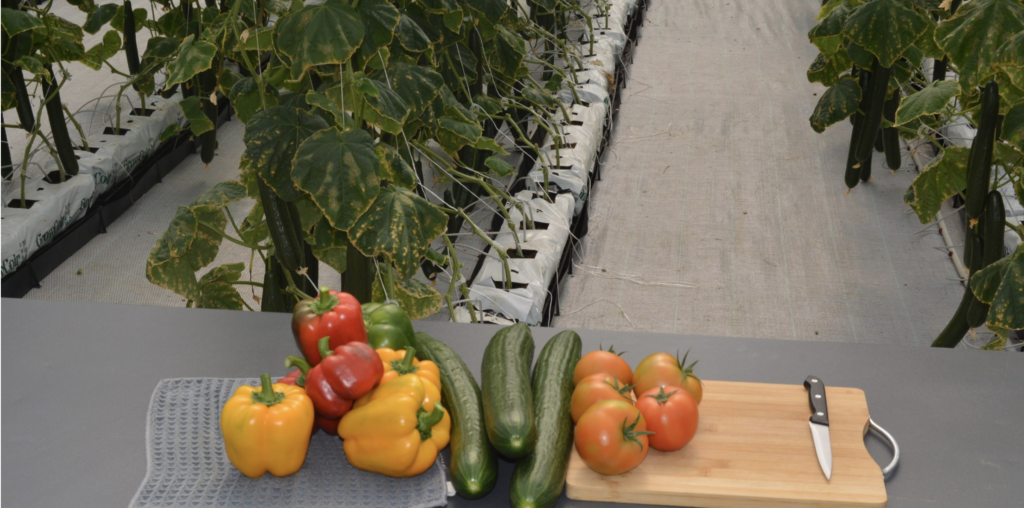
As of October 2024, Daures inaugurated its agricultural facilities which was facilitated by the former President, Dr. Nangolo Mbumba. On site, the project have a 1 hectare butterfly ventilated greenhouse facility that is fully automated with a roof vent system, side curtains, and circulation fans. Along with a fan nursery of 0.3 hectares, the forced-ventilation nursery has a closed roof structure and a forced-ventilation system with fans.
The facility is recorded to have a production capacity of up to 500 tons agricultural produce and can also produce about 150 000 seedlings. The facility already harvested its first agricultural produce which includes; Cucumber, Tomatoes and Peppers. Among the produce harvested, they were absorbed by local retailers in Erongo region namely; Woermann, Spar Walvis and Metro.
Daures Green Hydrogen Village also offers training and capacity building opportunities. The project site currently features the below facilities; training center, laboratory facilities, mini wind, solar and butterfly configuration, demonstration electrolyser facility for training and research, campsite included to accommodate students and researchers, energy production equipment, water production and treatment facility and the agri facilities.
Daures Green Hydrogen Village is truly on a journey to develop Africa`s first green hydrogen village on a semi-industrial scale, showcasing a green circular economy and green industrialisation. As Daures journey evolves, their story will be the testament of how green hydrogen and agriculture holds promise for a sustainable and resilient agricultural future.